Innovations based on experience
Research activities at EHTIC are conducted by interdisciplinary teams of experts from the Faculty of Biomedical Engineering at the Silesian University of Technology.
Our scientific expertise comes from from three departments:
- the Department of Medical Informatics and Artificial Intelligence,
- the Department of Biomaterials and Medical Device Engineering,
- the Department of Biomechatronics.
We have 15 years of experience in education and conducting advanced research. During this time, our teams have established a strong market position by collaborating intensively with companies from various industries, including the IT sector, medical facilities, and research institutions.
Thanks to our long-standing partnerships within the industry and our participation in numerous domestic and international projects, we are able to develop innovative solutions that bridge the gap between modern engineering, biology, and medicine. We effectively respond to contemporary healthcare challenges by implementing projects with high practical and market potential, combining advanced technologies such as artificial intelligence, 3D modelling, and biomaterials engineering.
Innovations based on experience
Research activities at EHTIC are conducted by interdisciplinary teams of experts from the Faculty of Biomedical Engineering at the Silesian University of Technology.
Our scientific expertise comes from from three departments:
- the Department of Medical Informatics and Artificial Intelligence,
- the Department of Biomaterials and Medical Device Engineering,
- the Department of Biomechatronics.
We have 15 years of experience in education and conducting advanced research. During this time, our teams have established a strong market position by collaborating intensively with companies from various industries, including the IT sector, medical facilities, and research institutions.
Thanks to our long-standing partnerships within the industry and our participation in numerous domestic and international projects, we are able to develop innovative solutions that bridge the gap between modern engineering, biology, and medicine. We effectively respond to contemporary healthcare challenges by implementing projects with high practical and market potential, combining advanced technologies such as artificial intelligence, 3D modelling, and biomaterials engineering.
Innovations based on experience
Research activities at EHTIC are conducted by interdisciplinary teams of experts from the Faculty of Biomedical Engineering at the Silesian University of Technology.
Our scientific expertise comes from from three departments:
- the Department of Medical Informatics and Artificial Intelligence,
- the Department of Biomaterials and Medical Device Engineering,
- the Department of Biomechatronics.
We have 15 years of experience in education and conducting advanced research. During this time, our teams have established a strong market position by collaborating intensively with companies from various industries, including the IT sector, medical facilities, and research institutions.
Thanks to our long-standing partnerships within the industry and our participation in numerous domestic and international projects, we are able to develop innovative solutions that bridge the gap between modern engineering, biology, and medicine. We effectively respond to contemporary healthcare challenges by implementing projects with high practical and market potential, combining advanced technologies such as artificial intelligence, 3D modelling, and biomaterials engineering.
Faculty of Biomedical Engineering
Departnemt of Medical Informatics and Artificial Intelligence
Modern Engineering for Health
The Department of Medical Informatics and Artificial Intelligence is a leading research and educational centre that sets standards in advanced methods of medical data acquisition, analysis and processing. Our teams combine medical knowledge with state-of-the-art technologies to meet the challenges of modern healthcare and improve the quality of life of patients.
Artificial Intelligence and Data Processing in Medicine
The main pillar of our activity is the use of artificial intelligence (AI) and cloud computing in therapeutic and diagnostic processes. We specialise in:
- Processing of one- and multi-dimensional as well as multi-modal medical data.
- The use of AI algorithms in the analysis of biological signals.
- The design of digital systems dedicated to medicine and the development of bioinformatics and computational biology.
Innovative Diagnostics and Computer Assistance
The Department has developed a number of proprietary computer-assisted diagnostic and therapeutic systems. Our solutions are used in:
- Imaging diagnostics and histopathology, where AI systems support diagnostic accuracy.
- Image navigation used in oncological diagnostics and therapy.
- Teleradiology and medical biometrics.
Telemedicine, Rehabilitation and Patient Monitoring
We develop technologies that enable patient care outside of medical facilities. Our areas of expertise include:
- Telecare and telerehabilitation, including modern interactive rehabilitation.
- Monitoring of medical parameters, such as pain monitoring in physiotherapy and supervision of chronic skin wound healing.
- Diagnosis of speech defects and modelling of biological processes.
Engineering the Future: From Genetics to Artificial Organs
Our research teams go beyond traditional computer science, engaging in projects in the fields of tissue engineering, genetic engineering and artificial organ design. We also conduct research on biomorphic materials, combining materials engineering with digital technologies.
Cooperation with Industry and Science Worldwide
As an active partner for business and science, we engage in various forms of cooperation:
- Research Projects: We carry out numerous domestic and international projects, covering both basic and applied research.
- Strategic Partnership: We cooperate with medical facilities, research institutions and IT companies, implementing projects with high implementation potential.
- Knowledge Exchange: We organise workshops, training courses and conferences, promoting the latest achievements at the intersection of medicine and computer science.
Faculty of Biomedical Engineering
Departnemt of Medical Informatics and Artificial Intelligence
Modern Engineering for Health
The Department of Medical Informatics and Artificial Intelligence is a leading research and educational centre that sets standards in advanced methods of medical data acquisition, analysis and processing. Our teams combine medical knowledge with state-of-the-art technologies to meet the challenges of modern healthcare and improve the quality of life of patients.
Artificial Intelligence and Data Processing in Medicine
The main pillar of our activity is the use of artificial intelligence (AI) and cloud computing in therapeutic and diagnostic processes. We specialise in:
- Processing of one- and multi-dimensional as well as multi-modal medical data.
- The use of AI algorithms in the analysis of biological signals.
- The design of digital systems dedicated to medicine and the development of bioinformatics and computational biology.
Innovative Diagnostics and Computer Assistance
The Department has developed a number of proprietary computer-assisted diagnostic and therapeutic systems. Our solutions are used in:
- Imaging diagnostics and histopathology, where AI systems support diagnostic accuracy.
- Image navigation used in oncological diagnostics and therapy.
- Teleradiology and medical biometrics.
Telemedicine, Rehabilitation and Patient Monitoring
We develop technologies that enable patient care outside of medical facilities. Our areas of expertise include:
- Telecare and telerehabilitation, including modern interactive rehabilitation.
- Monitoring of medical parameters, such as pain monitoring in physiotherapy and supervision of chronic skin wound healing.
- Diagnosis of speech defects and modelling of biological processes.
Engineering the Future: From Genetics to Artificial Organs
Our research teams go beyond traditional computer science, engaging in projects in the fields of tissue engineering, genetic engineering and artificial organ design. We also conduct research on biomorphic materials, combining materials engineering with digital technologies.
Cooperation with Industry and Science Worldwide
As an active partner for business and science, we engage in various forms of cooperation:
- Research Projects: We carry out numerous domestic and international projects, covering both basic and applied research.
- Strategic Partnership: We cooperate with medical facilities, research institutions and IT companies, implementing projects with high implementation potential.
- Knowledge Exchange: We organise workshops, training courses and conferences, promoting the latest achievements at the intersection of medicine and computer science.
Faculty of Biomedical Engineering
Department of Biomaterials and Medical Device Engineering
Our mission is to combine materials science with the practical needs of modern surgery and dentistry.
Advanced Research in Biomaterials and Manufacturing Technologies
- Metal biomaterials: Development of materials with modified structure and precisely defined mechanical properties for use in safe implants.
- Medical ceramics: Research on resorbable materials, bone cements and dental cements.
Hybrid technologies: Production of advanced polymer-ceramic layers. - Precision thermal processing: We have facilities that allow calcination at operating temperatures of up to 1650°C.
Designing New Generation Implants
- Shape memory implants: Utilisation of the superelasticity effect in the stabilisation of bone fractures, soft tissues and in the correction of spinal and craniofacial deformities.
- Surgical tools: Design of specialised instruments to support the work of doctors.
- Assessment procedures: Comprehensive support in the assessment of medical devices prior to their market launch.
Surface Engineering and Rapid Prototyping
We use cutting-edge surface modification techniques to enhance the biocompatibility and functionality of materials. These methods include ALD (Atomic Layer Deposition), the sol-gel method and electrophoresis, among others.
- Porosity modelling: We analyse and design the surface structure of biomaterials.
- Modern protective coatings: We conduct research on passive carbon, ceramic and polymer coatings on metal substrates.
- Rapid prototyping: We use rapid prototyping methods to accelerate the design process in medicine.
Strength, corrosion and safety
A key element of our work is ensuring the durability of implants in the challenging environment of the human body. We conduct:
- Mechanical testing: Evaluation of the properties of biomaterials under static and dynamic loads.
- In vitro durability testing: testing the durability of products in an environment containing physiological fluids and tissues.
- Corrosion diagnostics – analysis of resistance to pitting, crevice, stress and fatigue corrosion, and testing of degradation in polymer and composite biomaterials.
Faculty of Biomedical Engineering
Department of Biomaterials and Medical Device Engineering
The Department’s scientists and engineers are experts in the development of modern materials for medicine and the implementation of pioneering solutions in cooperation with industry. Our mission is to combine materials science with the practical needs of modern surgery and dentistry.
Advanced Research in Biomaterials and Manufacturing Technologies
- Metal biomaterials: Development of materials with modified structure and precisely defined mechanical properties for use in safe implants.
- Medical ceramics: Research on resorbable materials, bone cements and dental cements.
Hybrid technologies: Production of advanced polymer-ceramic layers. - Precision thermal processing: We have facilities that allow calcination at operating temperatures of up to 1650°C.
Designing New Generation Implants
- Shape memory implants: Utilisation of the superelasticity effect in the stabilisation of bone fractures, soft tissues and in the correction of spinal and craniofacial deformities.
- Surgical tools: Design of specialised instruments to support the work of doctors.
- Assessment procedures: Comprehensive support in the assessment of medical devices prior to their market launch.
Surface Engineering and Rapid Prototyping
We use cutting-edge surface modification techniques to enhance the biocompatibility and functionality of materials. These methods include ALD (Atomic Layer Deposition), the sol-gel method and electrophoresis, among others.
- Porosity modelling: We analyse and design the surface structure of biomaterials.
- Modern protective coatings: We conduct research on passive carbon, ceramic and polymer coatings on metal substrates.
- Rapid prototyping: We use rapid prototyping methods to accelerate the design process in medicine.
Strength, corrosion and safety
A key element of our work is ensuring the durability of implants in the challenging environment of the human body. We conduct:
- Mechanical testing: Evaluation of the properties of biomaterials under static and dynamic loads.
- In vitro durability testing: testing the durability of products in an environment containing physiological fluids and tissues.
- Corrosion diagnostics – analysis of resistance to pitting, crevice, stress and fatigue corrosion, and testing of degradation in polymer and composite biomaterials.
Faculty of Biomedical Engineering
Department of Biomechatronics
Innovative Solutions for Medicine and Industry
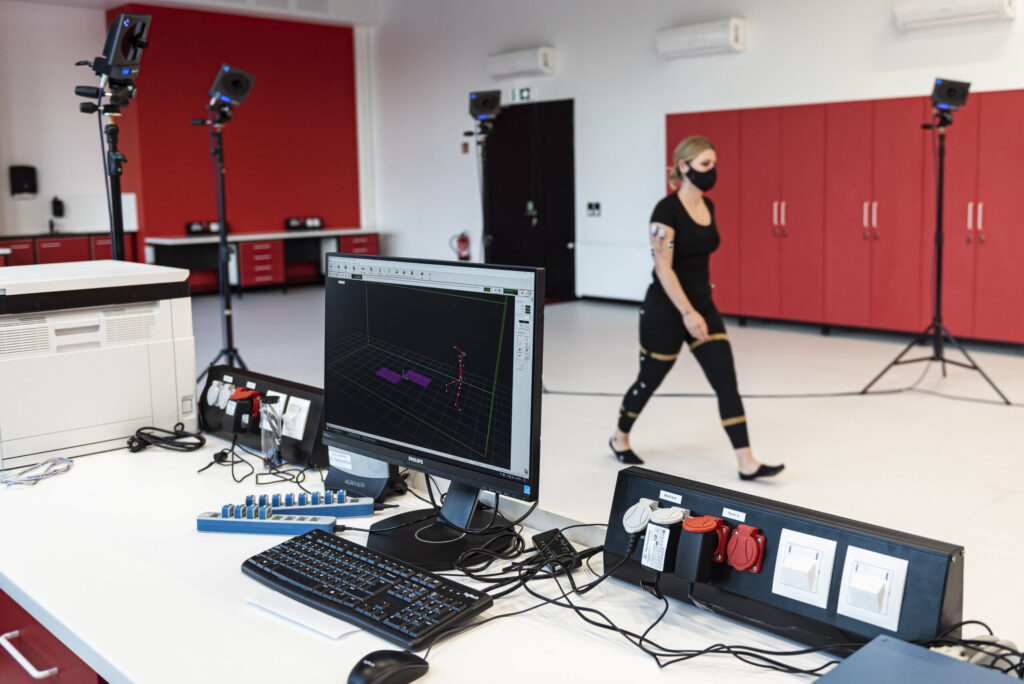
The Department of Biomechatronics is a dynamically developing unit whose activities focus on advanced diagnostics, modelling and testing. Our research forms the foundation for modern engineering and medicine, combining the world of technology with biology.
3D Modelling and Surgical Assistance
As part of its support for modern medicine, the Department carries out innovative projects in the field of medical, rehabilitation and sports equipment. We use advanced technologies to:
- Generate 3D models of tissue structures based on medical imaging (CT, MRI).
- Create spatial models using three-dimensional scanning.
- Provide engineering support for the planning of complex surgical procedures.
Biomechanical Analysis and Movement Dynamics
Comprehensive analysis of the musculoskeletal system is a key pillar of our activity. We conduct research for both medical and professional sports purposes, including:
- Kinematic analysis of human body movement and mechanical systems.
- Experimental diagnostics of the musculoskeletal system and assessment of athletes’ motor skills.
- Numerical simulations and development of models of multi-link system dynamics, including the human musculoskeletal model.
Virtual Reality (VR) in Science and Practice
We use Virtual Reality (VR) technology and 3D projections to create interactive visualisations. This makes it possible to create any environment – from faithful representations of reality to fantasy worlds – which is widely used in prototype testing and training.
A Digital Bridge Between Engineering and Biology
The work of the Department of Biomechatronics can be compared to that of an aeronautical engineer who tests a virtual prototype of an aircraft in a wind tunnel before it is built. We create and study digital models of the human body and medical equipment in order to optimise treatments and design completely safe solutions.
Faculty of Biomedical Engineering
Department of Biomechatronics
Innovative Solutions for Medicine and Industry
The Department of Biomechatronics is a dynamically developing unit whose activities focus on advanced diagnostics, modelling and testing. Our research forms the foundation for modern engineering and medicine, combining the world of technology with biology.
3D Modelling and Surgical Assistance
As part of its support for modern medicine, the Department carries out innovative projects in the field of medical, rehabilitation and sports equipment. We use advanced technologies to:
- Generate 3D models of tissue structures based on medical imaging (CT, MRI).
- Create spatial models using three-dimensional scanning.
- Provide engineering support for the planning of complex surgical procedures.
Biomechanical Analysis and Movement Dynamics
Comprehensive analysis of the musculoskeletal system is a key pillar of our activity. We conduct research for both medical and professional sports purposes, including:
- Kinematic analysis of human body movement and mechanical systems.
- Experimental diagnostics of the musculoskeletal system and assessment of athletes’ motor skills.
- Numerical simulations and development of models of multi-link system dynamics, including the human musculoskeletal model.
Virtual Reality (VR) in Science and Practice
We use Virtual Reality (VR) technology and 3D projections to create interactive visualisations. This makes it possible to create any environment – from faithful representations of reality to fantasy worlds – which is widely used in prototype testing and training.
A Digital Bridge Between Engineering and Biology
The work of the Department of Biomechatronics can be compared to that of an aeronautical engineer who tests a virtual prototype of an aircraft in a wind tunnel before it is built. We create and study digital models of the human body and medical equipment in order to optimise treatments and design completely safe solutions.
